

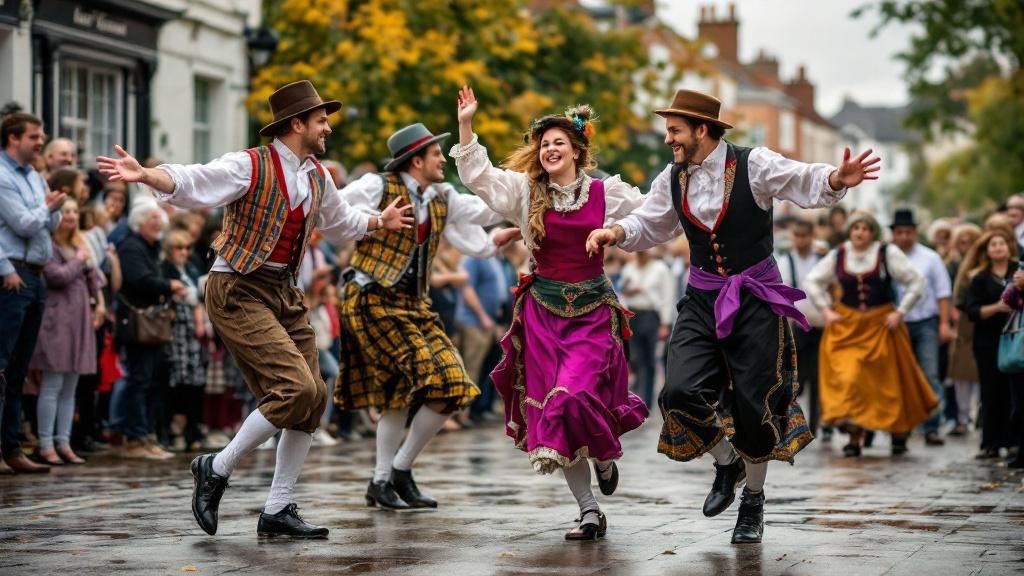
Once overlooked as a nostalgic echo of England’s countryside traditions, Morris dancing is undergoing an remarkable comeback amongst Britain’s younger generation. From university societies to country spaces, practitioners under the age of thirty are reconnecting with the rhythmic footwork, tinkling bell accoutrements, and colourful costumes that have defined this long-established practice. This article examines the factors driving this artistic renaissance, examines how contemporary performers are reworking the style, and considers what this renewed interest reveals about contemporary British attitudes towards cultural legacy and collective identity.
The Revival of Morris Dance
The revival of Morris dancing amongst young people across Britain demonstrates a notable shift from decades of declining participation. What was once perceived as an purely rural or older pursuit has evolved into a dynamic cultural phenomenon, with university societies, urban dance groups, and community groups actively embracing the tradition. This resurgence challenges established stereotypes and demonstrates that young people today find genuine value in preserving and celebrating Britain’s cultural heritage, reinvigorating practices that looked set for obscurity.
This revived interest transcends basic heritage nostalgia; young performers are consciously reimagining Morris dancing for today’s world. They incorporate contemporary music, try out innovative choreography, and build open-minded collectives that embrace dancers without regard to background or prior experience. The movement demonstrates a wider cultural change wherein British youth increasingly seek authentic connections to their heritage whilst concurrently reconceiving what tradition means, fostering a dynamic dialogue between heritage fidelity and modern artistic interpretation that resonates with what matters to their age group.
Why Young People Are Adopting This Classic Artistic Practice
Morris dancing’s appeal to younger generations goes well past nostalgic curiosity. Contemporary dancers embrace the art form’s substantial cultural legacy whilst valuing its potential for creative expression and social connection. The accessibility of modern Morris groups, paired with their inclusive ethos, has reshaped the perception of this conventionally closed-off pursuit. Young people are discovering that Morris dancing delivers a genuine alternative to standard recreational pursuits, affording both physical challenge and authentic social connection in an ever more digital world.
Belonging and Connection
In an period marked by social fragmentation, Morris dancing groups provide young people with concrete social networks built upon shared values and joint participation. The welcoming character of contemporary Morris organisations actively welcomes newcomers irrespective of background or experience, fostering genuine friendships and meaningful connections. Participants frequently characterise their dancing cohorts as chosen families, offering emotional support and a sense of place that extends well beyond the dancing calendar. This communal feeling proves especially important for young people navigating the shift from education to work.
The collaborative framework of Morris dancing inherently encourages team cohesion and shared accountability. Each dancer’s contribution directly influences the group’s synchronized appearance and rhythmic precision, creating interconnectedness that reinforces social bonds. Many young dancers report that their Morris groups foster real friendships in ways that standard social spaces regularly fail to accomplish. The shared commitment to sustaining and advancing this cultural heritage creates a powerful sense of common goal amongst participants.
Exercise and Movement and Health and Wellness
Morris dancing requires considerable physical exertion, combining cardiovascular exercise with complex coordination and strength development. Young dancers gain enhanced physical capability whilst engaging in activity that carries cultural significance rather than simply functional. The repetitive, rhythmic character of Morris footwork offers meditative qualities alongside bodily fitness, contributing positively to mental wellbeing. Participants frequently cite the holistic health benefits as a main reason for sustained involvement in their local Morris groups.
Beyond heart health advantages, Morris dancing cultivates proprioceptive awareness and physical self-assurance, particularly valuable for young people struggling with body image concerns. The emphasis on accuracy and technical skill and collective synchronisation shifts attention away from appearance-based anxiety toward competence and accomplishment. Furthermore, the outdoor performance tradition linked to Morris dancing encourages participants to interact with the natural world and the rhythms of the seasons, enhancing mental health through engagement with the natural world and cultural heritage.
Regional Variations and Modern Adaptations
Morris dancing traditions vary significantly across Britain’s localities, with each locality establishing unique approaches embodying regional history and geography. The Cotswolds maintain the vigorous, athletic “Cotswold” approach, whilst the North West prefers the more elaborate “Northwest” tradition featuring intricate dress and intricate formations. Younger dancers are eagerly taking up these area-specific traditions, engaging in instruction and events to learn traditional practices whilst appreciating the cultural nuances contained in each tradition. This spatial range provides contemporary performers with multiple entry points into Morris dancing, enabling them to engage with heritage rooted in their home regions.
Modern adaptations are concurrently expanding Morris dancing’s appeal outside traditional contexts. Younger practitioners incorporate contemporary music, experimental choreography, and inclusive casting practices, questioning historical gender and age restrictions. Mixed-gender sides and LGBTQ+ Morris groups have developed, fundamentally reshaping the tradition’s social dynamics. These innovations maintain the essential character—rhythmic footwork, bells, and festive energy—whilst making the practice more accessible and relevant to contemporary participants. Such imaginative reimagining demonstrates that heritage traditions needn’t remain static, successfully connecting historical authenticity with modern sensibilities.
The Prospects of Morris Dancing in Britain
As Morris dancing remains popular with younger audiences, the tradition stands at a pivotal juncture. Contemporary dancers are deliberately transforming the form whilst honouring its historical foundations, introducing fresh choreography and welcoming approaches that appeal to modern sensibilities. Universities document unprecedented enrolment in Morris societies, whilst festivals welcome exceptional participation of young participants. This momentum suggests the art form is moving beyond nostalgic curiosity to legitimate contemporary practice, establishing sustainable foundations for sustained development and lasting significance within British communities throughout the UK.
Looking ahead, Morris dancing’s trajectory appears remarkably promising. The convergence of social media promotion, straightforward instruction approaches, and younger generations’ hunger for authentic social cohesion creates ideal conditions for thriving. Organisations are supporting mentorship programmes and area-based tournaments, developing talent pathways and enabling skill transmission between seasoned and emerging dancers. Should this enthusiasm persist, Morris dancing may finally move beyond its image as exclusively tradition-centred, instead becoming established as a dynamic, developing art form that substantially enhances contemporary British society and deepens social connections across generations.
